 It has been 83 years since the U.S. Army Transport Dorchester was struck by a German submarine on February 3, 1943. In the chaos that followed, four Army chaplains, each representing a different faith, spread out among the soldiers, calming the frightened, tending to the wounded, and guiding the disoriented toward safety.
To understand their sacrifice, we must take a step back in time to 1943.
The Dorchester was a 368-foot steamship operated by the War Shipping Administration. In January 1943, it departed New York as part of a convoy bound for the Army Command Base at Narsarsuaq in southern Greenland. The journey required the ship to navigate icy waters between Newfoundland and Greenland—an area heavily infested with German U-boats.
Shortly after midnight on February 3, 1943, the Dorchester was torpedoed by a German U-boat in the Labrador Sea off Greenland. According to official records, the steamship sank in just 20 minutes.
There were 904 people aboard the Dorchester. Tragically, 675 of them drowned or died of hypothermia in the freezing waters. The sinking is believed to be the worst single loss of life for a U.S. convoy during World War II.
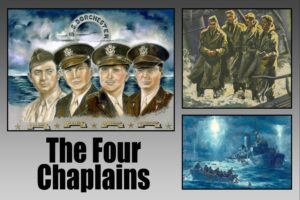
The tragedy of the Dorchester is remembered most for the extraordinary sacrifice of the “Four Chaplains,” all of whom were Army first lieutenants who went down with the ship.
After the torpedo struck, the chaplains helped guide men below deck to the lifeboats and assisted in handing out life jackets. When the supply ran out, they gave away their own.
One survivor, 19-year-old Daniel O’Keefe of the U.S. Merchant Marine Service, recalled, “Just before our ship went down, these chaplains took off their own life preservers and gave them to us. They were standing on the deck praying hand-in-hand as our lifeboat drifted out of sight.”
Another survivor, John Ladd, later said, “It was the finest thing I have seen or hope to see this side of heaven,” as he remembered the chaplains’ final moments.
Survivor William Bednar described the scene in a 1997 interview with The Baltimore Sun: “I could hear men crying, pleading, praying, and swearing. I could also hear the chaplains preaching courage to the men. Their voices were probably the only things that kept me sane.”
The Four Chaplains
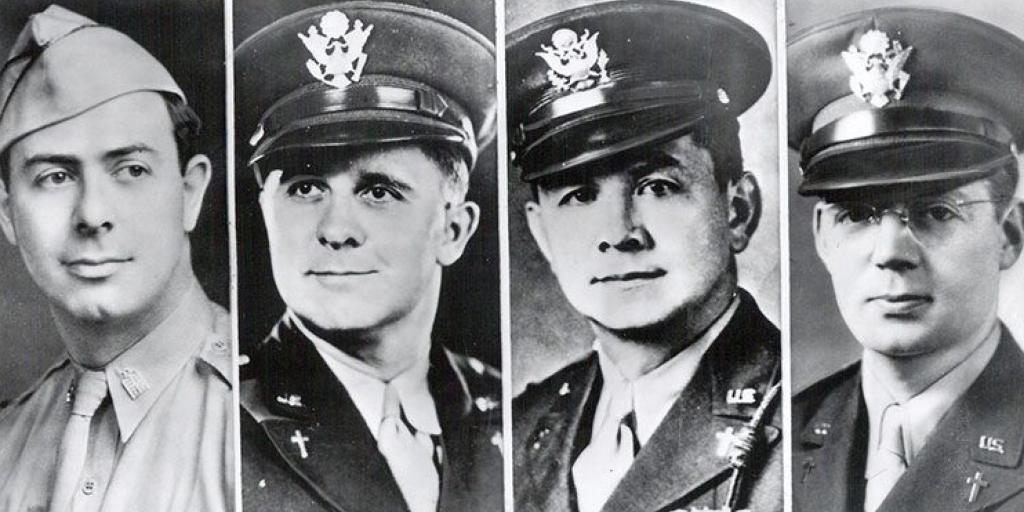
The Four Chaplains were Lt. George L. Fox, a Methodist minister from Pennsylvania; Lt. Alexander D. Goode, a Reform rabbi from New York; Lt. Clark V. Poling, a minister of the Reformed Church in America from Ohio; and Lt. John P. Washington, a Roman Catholic priest from New Jersey. The men became close friends after being assigned to Camp Myles Standish in Massachusetts prior to their overseas deployment.
Lt. George L. Fox, a native of Lewistown, Pennsylvania, lied about his age at 17 during World War I to enlist in the Marines as a medical assistant and train as an ambulance driver. Between the wars, he completed high school, married, and began his religious career. Fox graduated from Illinois Wesleyan University in Bloomington and studied at the Boston University School of Theology, where he was ordained a Methodist minister. After the outbreak of World War II, Fox enlisted for chaplain duty at the age of 42. He told his wife, Isadora, “I’ve got to go. I know from experience what those boys are about to face. They need me.” He began active duty on August 8, 1942.
Lt. Alexander D. Goode was a native of Brooklyn, New York, and an accomplished athlete and scholar. He dreamed of becoming a rabbi like his father and received his rabbinical ordination from Hebrew Union College in New York in 1937. Goode later served at Temple Beth Israel in York, Pennsylvania, and earned his Ph.D. in Middle Eastern languages from Johns Hopkins University. After the attack on Pearl Harbor, he joined the Army Air Forces as a chaplain and lobbied to serve closer to the front lines. He left behind his wife, Theresa, and his three-year-old daughter, Rosalie. Weeks after the chaplains were lost, Rabbi Philip S. Bernstein of the National Jewish Welfare Board said, “He believed that life would not be worth living in a world under Axis domination, and he was prepared to sacrifice even life itself for the cause of human freedom.”
Lt. Clark V. Poling was the youngest of the Four Chaplains. Ordained to the Christian ministry in 1936 at the age of 26, Poling came from a long line of clergy and was a seventh-generation Dutch Reformed minister. He served at the First Dutch Reformed Church of Schenectady, New York, and once said, “Just that I shall do my duty and have the strength, courage, and understanding of men. Just pray that I shall be adequate.”
Lt. John P. Washington was born into a large Irish family in New Jersey. As a child, he loved music, took piano lessons, and sang in his church choir. After graduating from Seton Hall, he studied at Immaculate Conception Seminary in Darlington, New Jersey, before being ordained as a priest. Prior to joining the Army in May 1942, he served as assistant pastor of St. Stephen’s Church in Kearny, New Jersey.
Courage Beyond the Dorchester 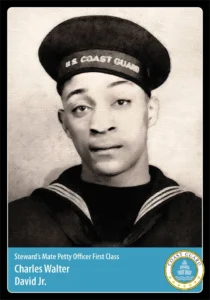
As the Dorchester sank, the Coast Guard cutter Comanche ignored the threat of another U-boat attack and rushed to rescue survivors. Among its crew was Steward’s Mate 1st Class Charles Walter David Jr., a 26-year-old from New York City.
Despite the second-class status afforded to Black service members during World War II, David remained loyal to his ship and his shipmates. He climbed into lifeboats to hoist survivors aboard, many of whom were too weak or numb from the cold to climb on their own. During the rescue, Lt. Langford Anderson, the Comanche’s executive officer, slipped and fell into the freezing sea. David immediately dove in to save him.
After helping the last survivors aboard, David climbed the cargo net himself, only to see his friend, Storekeeper 1st Class Richard “Dick” Swanson, unable to continue after reaching halfway up. David went back down the net and lifted Swanson to safety.
Weeks later, David died of pneumonia at a hospital in Greenland as a result of the hypothermia he suffered during the rescue. As Coast Guard historian William H. Thiesen wrote, “Despite his secondary status in a segregated service, Charles Walter David Jr. placed the needs of others before his own.” For his heroism, David was posthumously awarded the Navy & Marine Corps Medal and, in 1999, received the Immortal Chaplains Prize for Humanity.
A Legacy That Endures
On February 3, 1951, President Harry S. Truman dedicated the Chapel of Four Chaplains in Philadelphia. Today, thousands of interfaith memorial services honoring the Four Chaplains are held across the nation each year, including at American Legion posts.
Their story remains a powerful reminder that faith, courage, and selflessness can unite people—even in the face of overwhelming darkness.
***Source: Military.com. “Honoring the Four Chaplains.” Available at: https://www.military.com/history/honoring-the-four-chaplains.html